
At Development Meets, Progress Comes Before Medals
A coaching perspective from Bálint Richter, founder and coach at Cybersmart Aquatics.
For young swimmers at development meets, real progress matters more than collecting medals. That is my starting point as a coach.
I want our swimmers to compete, learn to race and win. I also want them to build performances that hold up as the competition gets stronger. A medal count cannot tell me whether that is happening.
When I am judging development, I would rather see a fifth place with a genuine personal best than a medal collected while swimming well outside a previous best. The swimmer who misses the podium may have taken the bigger step forward.
Our earlier article, How to Recognise Swimming Progress Beyond the Stopwatch, looked at skills that times cannot fully capture. Here, I want to look at how we judge competitive results—and what we teach young swimmers to value.
Research and official sources are listed at the end of this article.
Read the performance behind the medal
A medal tells me where a swimmer finished against the people who entered. If the field is small, a swimmer can reach the podium without approaching their best. That placing is real; it simply does not establish improvement.
A personal best, or PB, is the swimmer’s fastest recorded performance in that event and course. Compare the same stroke and distance, keep 25-metre and 50-metre results separate, and use the official race time.
Consider two hypothetical results at different meets. One swimmer improves from 1:14.00 to 1:12.00 and finishes fifth. Another wins in 1:10.00, against a PB of 1:08.00. The winner is still faster. The fifth-placed swimmer has made the clearer improvement against their own benchmark.
For a developing swimmer, that improvement deserves proper recognition. It is an achievement in its own right.
Why a medal can feel bigger
A medal is easy to see, hold, photograph and show somebody. A PB needs context: someone has to understand the previous time and recognise what changed. That difference in visibility is one reason I think a medal can attract more attention.
But more attention does not establish that medals motivate every swimmer more than PBs.
A 2026 study of adult athletes’ first-medal experiences found that athletes remembered medals as sources of recognition, confidence and renewed motivation. These were retrospective accounts across several sports, not a comparison of medals and PBs in young swimmers.
A medal can mean much more than showing off. It may represent effort, belonging or the first moment an athlete believes they can compete successfully. I want to respect that while keeping the performance in view.
Wanting to improve and wanting to win can coexist
In achievement-goal research, a task focus means judging competence through learning and improvement; an ego focus means judging competence relative to other people. Research has found that these orientations can coexist.
“Ego” in that technical sense does not mean a child is arrogant. A swimmer can want to beat the field and be serious about improving their own performance.
My concern starts when a medal becomes enough on its own—when nobody asks whether the swim improved, whether the race plan worked or what needs attention next.
A study of 202 Norwegian swimmers aged 14–24 found that a coaching climate focused on learning and personal development was associated with greater intrinsic motivation and well-being, and less burnout. It was questionnaire-based, so it does not prove cause and effect.
That supports the direction I want to take as a coach: keep the ambition to win, and make improvement central to how we judge success.
We help shape what young swimmers value
A study of 408 swimmers aged 9–18 linked motivational experiences with influences from coaches, parents and peers, with differences by age. It was observational, but it reinforces the importance of the environment around a young swimmer.
I want our reaction to improvement to be as clear as our reaction to a podium. Name the PB. Explain the progress. Recognise the better turn or the improved pacing. A swimmer should be able to hear exactly what they did well, even without a medal around their neck.
A championship final has a different purpose
An SA national title, a Commonwealth Games medal, a world title or an Olympic medal carries a different significance from a routine development-meet podium. In a championship final, beating the field on the day is the decisive competitive outcome.
Léon Marchand won the Paris 2024 Olympic 400m individual medley in 4:02.95, having already swum 4:02.50 in 2023. His Olympic victory was outstanding without being a PB.
We should judge the result against the purpose of the meet. Learning to race for a place matters at local galas too. For developing swimmers, though, I will keep asking whether we are building the performance needed for stronger competition.
A PB during a training block tells me something useful
If a swimmer produces a genuine PB during normal training, without a special taper for that gala, I find that particularly encouraging. They have produced their fastest recorded swim without that planned reduction in training load.
A small randomised study of 24 male competitive swimmers, averaging around 16–17 years old, found that tapering improved 50m front-crawl performance in the taper group. Preparation matters when we interpret a race.
An untapered PB gives me useful evidence alongside the training history and race execution. It does not prove every part of the programme is right or guarantee another PB after tapering. Missing a PB during a training block does not, by itself, establish failure either.
Hard work must be productive
Training builds the performance we draw on at a gala. Concentration, consistent effort, attention to technique and responding to feedback all belong in that work. Recovery belongs there too.
In a study following 26 highly trained young swimmers, the group classified as functionally overreached responded less favourably to tapering than the acute-fatigue group. This small observational study challenges the assumption that more accumulated fatigue necessarily produces a better championship swim.
The IOC’s consensus on youth athletic development recommends individualised development, adequate recovery and an environment that is challenging and enjoyable.
Train with purpose. Recover properly. Bring that preparation to the race. A good session can be demanding and still leave room for enjoyment.
Progress comes first—not a demand for PBs every time
Even elite performances vary. Research analysing 676 race times from 51 Olympic swimmers documented variation within and between competitions. Those results do not set a standard for children; they show why a single race needs context.
I want to see the pattern over time: better execution, growing capability and improving performances. Repeated PBs can bring a swimmer closer to stronger competition. They cannot guarantee medals, because opponents improve and fields change.
After a gala, ask about the time, the quality of the swim, the meet’s purpose and the next step. Celebrate the medal when it comes. Give the PB proper recognition when it does not bring a podium.
For young swimmers at development meets, improvement comes before medal collecting. Keep the ambition to win. Build the performance that gives that ambition substance.
Research and official sources
- Kim, Im & Tang (2026), Athletes’ first-medal achievement experiences and perceived psychological resources: a qualitative multimethod study
- Roberts, Treasure & Kavussanu (1996), Orthogonality of achievement goals and its relationship to beliefs about success and satisfaction in sport
- Solstad & Lemyre (2014), Why Coaches should Encourage Swimmers’ Efforts to Succeed (PDF)
- Chan, Lonsdale & Fung (2012), Influences of coaches, parents, and peers on the motivational patterns of child and adolescent athletes
- World Aquatics (2024), Léon Marchand and Summer McIntosh crowned World Aquatics Athletes of the Year
- Larry Herr, World Aquatics (2024), Swimming Stats | Day 2 of the Paris 2024 Olympics
- Aouani et al. (2024), Optimizing performance and mood state in competitive swimmers through tapering strategies
- Bretonneau et al. (2024), Effect of the pre-taper level of fatigue on the taper-induced changes in performance in elite swimmers
- Bergeron et al. (2015), International Olympic Committee consensus statement on youth athletic development (PDF)
- Pyne, Trewin & Hopkins (2004), Progression and variability of competitive performance of Olympic swimmers
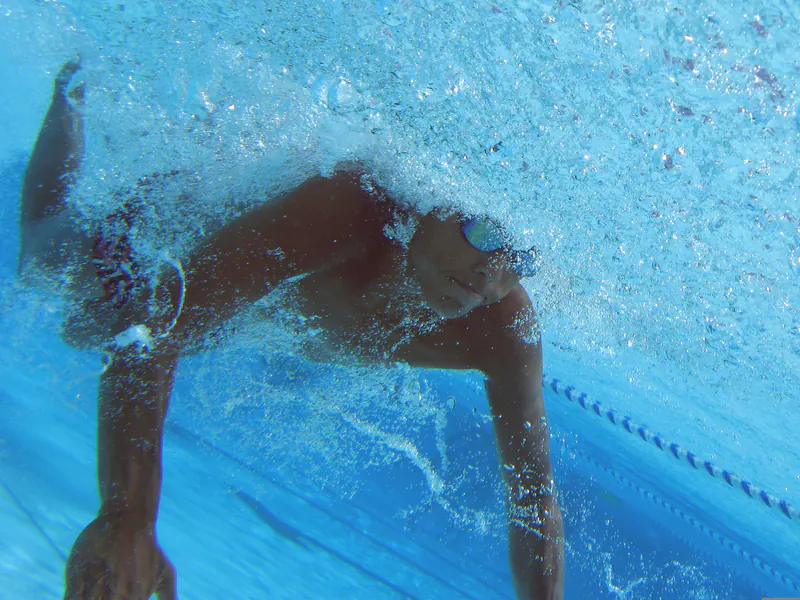
Illustrative photographs. Butterfly race at Camp Pendleton by Pfc. Sarah Wolff, U.S. Marine Corps. Australian Institute of Sport pool by KeepActive.com.au, CC BY-SA 4.0. Both resized for the site.

