
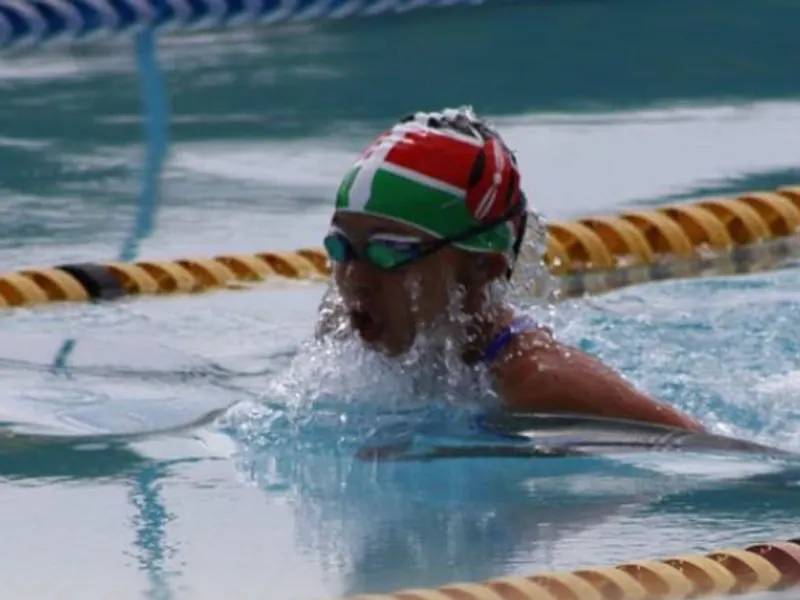
Katja’s Swimming Dream: A Mother’s Story of Perseverance and Fairness
A foreword from Cybersmart Aquatics
Katja Kimani is one of our swimmers at Cybersmart Aquatics, and we are proud to support her swimming journey. We thank her mother, Mia von Koschitzky-Kimani, for allowing us to share her personal account of Katja’s journey to represent Team Kenya at the Africa Aquatics Zone III Championships.
Mia’s article follows in full, with her wording, original title and subtitle unchanged. This foreword, the website headline and the accompanying images have been added by Cybersmart Aquatics.
Images supplied by Cybersmart Aquatics. The portrait is an excerpt from Kenya Aquatics-branded award artwork.
One Swimming Dream, and how we ended up at Kenya’s Sports Disputes Tribunal
A simple question about a swimmer’s selection — and what nobody answering it revealed. The Tribunal called it a “total breakdown of administrative transparency” and a violation of Kenya’s Constitution
By Mia von Koschitzky-Kimani
Originally published on 27 October 2026 on Substack. Republished with the author’s permission.
The CANA dream
Our daughter Katja is twelve, and she lives for her swimming. For years, swimming at the Africa Aquatics Zone III Championships (also known as CANA Zone III) and representing Team Kenya had been her dream, and the thing that drove her.
She had just turned ten the first time she came close, on a long list of four for the 100m backstroke. I still remember her at the dinner table when she found out, crying with joy. She did not make the final two, and that was fine. The next year we moved to Cape Town and could not get to the May nationals, but she still qualified on her February times, even if only for the B team.
This year was supposed to be the year. We flew to Nairobi in May so she could swim the national championships properly. She won her age group award, and on the national times swum over the previous twelve months she was the first or second fastest in a significant number of events. Zone III stopped being a hope and became a fixed thing in our calendar, something she trained towards and talked about and fully expected to be part of.
Then the criteria arrived
On 13 August, a bit more than two months to Cana, the selection criteria were published and caught us by surprise. A new short course Time Trial in Nairobi, five weeks later, would become the primary basis for ranking. Whatever a swimmer had done at the four national championships of the previous twelve months would now rank behind that single Time Trial. The athlete representatives record that the criteria were never put to them for an opinion before being released to the public.
That put us in a real bind. The Time Trial fell on the weekend of 19 and 20 September, at the end of Katja’s last week of term, a week in which she sat seven exams. She would have had to travel during that week. It also meant a second set of flights and accommodation in Nairobi within four months, after the trip for the May nationals, with a third journey to follow in October, to Kampala, where the championships themselves would be held, if she were selected. And it meant a long journey and a week out of the water in what should have been the key training period before Kampala.
Section 12 of the criteria set out a process for requesting an exemption on exceptional-circumstances grounds, and it seemed to match our case broadly enough to be worth asking. It says a swimmer unable to participate in the Time Trial “because of a documented exceptional circumstance may request consideration on the basis of previous verified performances”. The Tribunal later called it “a clear safety valve for athletes unable to attend the trial due to documented exceptional circumstances, such as international residence or schooling abroad”.
Our coach and club CEO, Balint Richter, read the criteria, got the times she had swum at a Short Course Championship in July verified by the Western Cape records officer and sent the Section 12 request in the evening of the same day the criteria document went up. Thirty-seven days before the Time Trial, in writing, addressed to the members of the National Athletes Selection Committee, at the federation’s official address as noted on the CANA criteria document.
We were not taking a yes for granted. Our reasons seemed to us to sit within what the provision described, but whether they qualified was Kenya Aquatics’ judgement to make, and it was entitled to say no. What we expected was an answer, quickly, while there was still time to do something with it. If the answer was yes, she would be assessed on her times. If it was no, we would have sat down and worked out whether we could somehow make the trip work, and whether we should, weighing the exams, the flights to Kampala five weeks after that, and what it would ask of the rest of the family. Either answer was something we could have planned around.
The decision never came.
Sixty-four days later a tribunal ordered Kenya Aquatics to put her on the team. What happened in between is what this piece is about. Somewhere in the middle of it, this became about much more than whether our daughter would swim in Kampala.
Seven weeks of trying to get an answer
At first we waited, patiently. After weeks of silence, and with the Time Trial getting closer, our head coach, Chanelle van Wyk, set out to get an answer. She wrote on 11 September and again on 14 September. Her emails were friendly, patient and increasingly specific. What came back were occasional acknowledgements, and no answers.
I wrote myself on 15 September, four days before the Time Trial, directly to the Chair of the Selection Committee. I explained the circumstances and set out Katja’s recent performances. She replied herself. My email was “well received”, she wrote, and would I kindly allow “the KA - EC and the NASC committee to deliberate and revert”. Nobody reverted. Four days later the Time Trial went ahead with the application still undecided.
Chanelle followed up again after the Time Trial, on 24 September, asking once more for a written decision. The reply that day, on which Kenya Aquatics copied in the President and the Chair of the Selection Committee, thanked her and said the federation would revert as soon as possible. No answer ever came back.
Our coaches in Cape Town have no stake in Kenyan swimming politics and nothing to gain from any of it. They read the criteria, attached times verified by the provincial records officer, wrote the application, forwarded it, chased it, wrote again. Katja is their swimmer and they care about her. None of it was a favour to us.
They could not understand what was happening. They asked me, more than once, whether they had done something wrong, whether there was anything else they needed to do, somebody else they needed to speak to.
For a while I explained it away. Things take time. Some people are new. The committee are volunteers. Everybody is busy with the Time Trial. It will come. Then the Time Trial came and went, and I ran out of excuses. I felt bad for them, and I was embarrassed: embarrassed on behalf of a federation my children swim for, in front of people who had only ever tried to help.
It was also the time I was ready to let it go. I was tired in a way I had not been before. Somewhere in those weeks I had stopped expecting an answer and started to believe that somebody had simply decided Katja was not going, and that the walls were there to be walked into until we gave up. I had used up the goodwill of coaches who should have been spending those evenings on training. Katja had been living between hope and no hope for six weeks, which is a great deal to ask of a twelve-year-old. And it was one gala. I remember thinking, quite clearly: is this worth what it is costing all of us?
Which is to say the silence had very nearly worked. This is how these things usually end. Not with a decision anybody has to put their name to, but with a family working out that it is not worth the trouble.
What changed is that my husband stepped in.
He put it to me plainly. This had stopped being about Katja. If they will do this to us, they are doing it to others, and if it works they will carry on doing it, and the next family may not have the means or the appetite or the nerve to object. A federation is not the property of whoever happens to be running it at the time. It belongs to every Kenyan who swims, and to the children who come after ours. And of course he was right.
Then he took it over. He wrote on 26 September, six weeks after the application had gone in, friendly but determined, and copied our lawyer. That changed the temperature. The Chair of the Selection Committee acknowledged it on 28 September, copying in the federation’s advocates.
The first document with any content in it arrived on the morning of 30 September, hours before the team was published. It came from the Selection Committee, sent to us by its Chair, and it ran to seventeen numbered sections. It discussed long course and short course times at length. It said her times had not been recorded in Kenya, a requirement that appears nowhere in the published criteria and that the Tribunal would later call legally infirm. In seventeen sections, it did not answer the exemption request.
On 30 September the team was published. Katja was not on it, not in the team and not on the reserve list. The list carried a notice: aggrieved swimmers had 48 hours to appeal, and would have an answer within seven days, “from selection committee”. We appealed the same afternoon. That made eight approaches from our side in seven weeks.
Then we read that notice again. The appeal would be decided by the same body that had left the application undetermined for seven weeks, had answered none of our questions, and had written the letter that arrived that morning. That was the point at which we accepted that no answer was coming from Kenya Aquatics, and on 5 October, with the final list about to be published, we filed at the Tribunal.
The only option left: Kenya’s Sports Disputes Tribunal
No parent wants to take their child’s federation to a tribunal. It cost money we suddenly had to find and should not have had to spend at all, and plenty of time none of us really had.
It also meant putting our twelve-year-old daughter’s name into a public dispute. And it’s a dispute against an organisation deciding which meets she is entered for and which teams she is considered for in the future, for as long as she swims for Kenya.
We went because the alternative was worse. If we had let it go, the lesson for Katja would have been that the rules apply until they are inconvenient, and that the correct response to being treated unfairly is to be quiet about it. That is not a lesson we are willing to teach our daughter.
On the morning of Monday 5 October the federation’s administrator posted in the Kenya Aquatics group that the final swimmers list would be released by the end of the day. We filed at the Tribunal by noon. The post was later deleted from the group. If anything it made the decision easier. The list was being finalised while our appeal sat unanswered, and nothing suggested that an independent review had ever been planned for at all.
The next day the President wrote to all stakeholders announcing that he had constituted an Alternative Dispute Resolution (ADR) Committee of five members. This was, he wrote, “in line with our commitment to fair play and use of internal dispute resolution mechanisms before escalating externally”. I could not help it, but it felt quite ironic to me at the time. Its composition and terms of reference, he said, would be communicated shortly.
They were communicated on 8 October, towards the very end of their own response window. The five members are described in the federation’s own letter as swimming parents from three clubs, a friend of swimming and parent to former national swimmers, and a masters swimmer and club coach.
The following morning the nine-page appeal outcome arrived, sent to us by the Chair of the Selection Committee. It held the Committee’s own arguments and the panel’s findings, one after the other, and recommended that the appeal be dismissed. The heading read “Respondents’ Submissions and Proposed ADR Findings”. Nobody had taken the word “Proposed” out of it. Four of the five panel members had signed.
On the question we had actually asked, it said that “an exemption from the Selection Trial, where properly granted, does not constitute automatic selection”. True, and not an answer. Nowhere in nine pages does it say whether Katja’s exemption had been granted or refused.
It closed on a principle. “A fair national selection process does not necessarily mean selecting the swimmer with the fastest performance found anywhere in the world. It means selecting athletes according to the objective, published and consistently applied criteria established for that national selection process.” I agree with every word of that. It is what we had been asking for since 13 August, and it is what the Tribunal later found had not happened.
I cannot say whether that committee was independent. I am not saying it is impossible, but I do find it difficult to imagine how five people, appointed one day and reporting the next, independently deliberated and weighed both sides fairly in that time and argued their case in a nine-page document. It echoed the Committee’s own position, and reached the opposite conclusion from the one the Tribunal reached on the same facts a week later.
I also noticed who was on that committee, and who was not. One of the five also sits on the Selection Committee itself, the body whose decision was meant to be independently reviewed. The President announced that appointment publicly. The ADR Committee’s Chairman had himself been selected to the Zone III team by that same Selection Committee. At the same time the federation’s elected athlete representatives, whose whole function is to speak for swimmers in situations exactly like this one, were not on it at all.
When the only route to a fair hearing does not exist, going to a tribunal is not escalation. It is the first place anyone has actually listened.
The ruling is in. The battles continue.
The ruling came on Friday 16 October at one in the afternoon. It was delivered orally and it was brief: our claim had merit, and Kenya Aquatics was to include Katja in the team on the basis of her verified times. The federation’s advocate undertook to pass the message on to his clients. The championships began the following Wednesday in Kampala.
Nothing came from Kenya Aquatics that afternoon, or that evening. With nobody telling us anything, we contacted the team manager ourselves that same Friday. We asked for one thing that would let us plan: a formal communication from Kenya Aquatics confirming it would comply with the order, that Katja was on the team, and what her events were. She said she would follow up.
What followed was four days of improvisation: we booked the flights we had been barred from booking while the case was pending, she swam a local gala in Cape Town on the Saturday because it had been in her calendar for months, and she got on a plane on the Sunday.
Across that weekend Kenya Aquatics did write. They asked us to send them the ruling, and said that all communication should go through their advocates. Nothing about her accreditation, her entries, or where she should report.
The first confirmation came on Monday morning, after Eston followed up, from the Chair of the Selection Committee. Katja had been included in the team and her photograph submitted for accreditation. On her events, the letter said only this: “She has therefore been allocated events.” It did not say which. It felt shoddy. After everything that had gone before, that was what we had to go on. Two days before she raced, and shortly before she finally landed in Kampala.
There was also a parallel conversation running in the federation’s stakeholder group, KSF Stakeholders for Change, which I found very concerning. On 18 October, two days after the ruling and in the middle of the weekend we spent trying to get a confirmation out of anybody, a long essay was posted there, titled “When entitlement swims faster than merit: the rot in Kenyan swimming”. The same account posts the ADR Committee’s official statements in that group.
It was about parents. It described a sport that had become “a battleground of entitlement, intimidation, legal threats and power struggles”. It set out a sequence: “A letter arrives on Friday. A response is demanded by Saturday. By Monday, the matter is in court.” And it said that no parent should be allowed to “turn personal disappointment into a licence to terrorise an institution”.
It named nobody, and I cannot prove any of it was written about us. It certainly felt that way, and I do not believe the timing was a coincidence. To me it read as an attempt to discredit the parents who are willing to stand up for a system that works for every child.
The Committee was willing enough, while the case was still pending, to put our daughter’s name into a public statement in that same group. When the case ended, it said nothing there at all. Entries changed as a result, and I understand why the families affected, in the absence of being given any context, were upset.
What the Tribunal found
The written judgment reached us on 22 October. It is attached in full.
Sports Disputes Tribunal Judgment Sdtsc E082 Of 2026 Kimani V Kenya Swimming Federation (PDF)
A few passages are worth highlighting. I think they can stand for themselves.
On the application that was never answered: ignoring a properly invoked mechanism under the rules, “while at the same time admitting other swimmers who did not attend the trial, constitutes a grave breach of administrative fairness.”
On the rule that her times had not been recorded in Kenya: the justification for it was “legally untenable”, the criteria contain no such requirement, and introducing one afterwards is “an arbitrary, retrospective goalpost shift”. The requirement itself the Tribunal found “legally infirm”.
On the appeal: the body “did not exist” when we filed, and should have been constituted as early as 19 September, in anticipation of complaints. “To extend a right of appeal to a non-existent body” supports the claim that the process was “ineffective and futile”.
On the federation’s argument that no other swimmer had complained, and that one complainant should not be allowed to prejudice everyone else: “Just because everyone else complies without complaint doesn’t invalidate the claims of that single person, where those claims are genuine.”
And on the whole: the failure to produce the ranking sheets, to give case-specific reasons, or to determine a pending exemption request “represents a total breakdown of administrative transparency”.
Its orders declare that Katja’s exclusion from the team and the reserve list was “in direct breach” of Kenya Aquatics’ own Zone III Selection Criteria, that it denied her a reasonable opportunity to satisfy those criteria, and that it violated Article 47 of the Constitution and the principles of natural justice. And that “the selection was not conducted fairly, objectively and consistently within the published criteria”.
The part of it I care most about is paragraph 34. During the case we had asked the Tribunal to say something about process for the future, because none of this would have happened if a few ordinary things had been done in the right order. It did. Pointing Kenya Aquatics to the guidance in the Second Schedule to the Sports Act, it set out, among other things:
- “Publishing all applicable selection criteria within reasonable time before the commencement of the qualification period.”
- “Engaging in meaningful consultation with athlete representatives prior to implementing any material changes to selection methodologies.”
- “Determining any application made under exceptional-circumstances provisions within a reasonable time and certainly prior to final team selection.”
- “Importantly, establishing a clear, independent and timely internal review mechanism for selection disputes that conclude before entry deadlines.”
This is not about one swimmer
This is not only about Katja. The same Selection Committee produced other cases in the same months, and those are only the ones that left a paper trail. I have no way of knowing how many families asked a question, received no answer, and quietly let it go.
This year the same Tribunal also heard a claim brought by the parents of two other young swimmers left off the Kenyan team for the ANOCA Zone V Youth Games, in judgment SDTSC/E054/2026. The failure was the same one: a departure from the federation’s own published policy, which the Tribunal called “material and unjustified”, defended afterwards with reasons “unsupported by any primary record” of the committee’s deliberations. It did not send the decision back, finding that the federation had “already demonstrated inconsistency in applying the Selection Policy” and that a remittal would “fail to cure the defects”. That was in August, six weeks before we filed our own case.
It is also concerning that, as we learned in the course of this, the athlete representatives have been sidelined. Kenya Aquatics has two of them, elected to its Executive Committee. Through July and August they recorded in writing, more than once, that they were not involved in selection decisions, that they were not on the Executive Committee’s communication lists, and that federation documents reached them only once they had already been published. The federation apologised on 19 August. They sent a formal letter of concern on 21 August.
On 25 August, four days after that letter, one of the two resigned. He wrote that he could no longer represent athletes responsibly when representatives were “repeatedly excluded from important communication, consultation and decisions affecting athletes”, that he had never been given minutes of the Selection Committee’s deliberations, and that he could not “credibly explain, defend or accept collective responsibility for decisions and processes in which I was not properly informed, consulted or involved”. Athlete representation, he wrote, “must be substantive, not symbolic”.
It reached inside the Committee too. In the seventeen-section letter sent to us on 30 September, the Committee recorded that it had verbally cautioned one of its own members over a potential conflict of interest, after discussing with him instances where he had “sought to persuade the Committee to reconsider or compromise its position”, and had advised him that continued involvement might require him to step down from the Committee. On 9 October, four days after we filed at the Tribunal, the Chair of the Selection Committee issued a public statement in a stakeholders group asking him to recuse himself from the Committee pending the hearing and determination of what the statement called “the Katja matter”.
The statement called the request a temporary “governance measure intended to safeguard the integrity, impartiality and credibility of the selection process”, and “not a personal vendetta”.
When I asked him about it, his account was that he had argued all along that the Time Trial was a good idea, but that the notice for this year was far too short, and that it should have been brought in for the next season instead. I found it a reasonable position.
I have no window into that Committee, and I have no issue with a recusal where one is genuinely needed. I do find the timing curious though since by 9 October the Alternative Dispute Resolution Committee was in place and it was thus not for the Selection Committee to make decisions anymore. It landed on a coach who has not coached Katja since we moved to Cape Town, while the coaches actually coaching her never received a decision at all. It made me wonder whether this was an attempt to sideline yet another stakeholder who refused to just fall in line.
So: two tribunal rulings eight weeks apart, both lost by the federation, both turning on criteria applied inconsistently and reasons never given; athlete representatives who say they cannot do the job they were elected to do; and a committee member asked to step aside after being recorded as disagreeing. These are not isolated administrative lapses. It is the same failure repeating, and each time it is a child who pays for it.
Do we have a vision for Kenyan swimming?
Those are the failures a tribunal can rule on. But there is a larger question sitting behind all of them.
Because I have come to think that most of what we went through comes back to something simpler than bad faith. There is no vision for Kenyan swimming big enough to organise anybody’s attention. When an institution is not working towards anything in particular, every decision becomes a question of who made it and whom it favours, and the people inside it spend their time defending positions instead of building something. Ambition is what makes priorities obvious.
You can see it in something as small as when the team’s coaches are appointed. Ours were announced on 13 October, eight days before a championship that had been in the calendar for a year. That is no way to set anybody up: coaches need to know the swimmers, see their programmes and plan the final weeks of training with their club coaches. The Uganda team had been training together for five weeks by then, at the pool where the championships were held. An institution working towards something does not appoint its coaches this late.
And let us be more ambitious than we are. When is a Kenyan swimmer going to stand on an Olympic podium? Why should that be out of reach, in a country that taught the world how to run? Nobody ever told those runners that their ambitions were unreasonable. So let us ask the real question. What would it take? Brisbane is six years away, and that will be prime time for most of the swimmers who raced at Zone III this week. Let us work towards it: decide it, write it down, and work backwards from it. That is where the energy of a federation belongs, and not in a fight over event entries at a regional championship. Without a goal of that kind, clearly set out and genuinely held, we will keep ending up in small fights like this one. And small fights get nobody anywhere.
And then the work becomes obvious. Supporting our coaches. Planning a season in advance, and making the decisions with athletes and parents rather than around them. Finding funded opportunities for the swimmers who have earned them. Those are only examples, and the list goes on.
The dream comes true, at last
In the end Katja did swim in Kampala, in all the events she had qualified for. Her entries were sorted out the day before the championships began, by the coaching staff, as the Tribunal had ordered.
She did win five individual golds and two silvers, in addition to a silver and a bronze relay medal for Team Kenya. She received the Victrix award for being the best female swimmer in her age group. Not everything went to plan: Katja added eight seconds to a personal best in one event, and turned a sure gold into a disqualification in another after thinking she had another two laps to go. That’s sport.
I believe she has shown in that pool that she belonged on that team.
I am also extremely proud of the whole Kenya Zone III team: the coaching staff who were appointed only days before the competition, and the swimmers, who raced their hearts out that week under challenging conditions, with very little explained to anybody by the leadership, and swam anyway. We have a team that can perform against all odds. I really do hope that one of them brings home that Olympic medal for Kenya one day.